Showing posts with label ezra taft benson manual. Show all posts

Saturday, September 26, 2015

Teachings of Presidents of the Church: Ezra Taft Benson Chapter 18: Beware of Pride

This chapter is FULL of great truths and warnings.  There is NO WAY I will get through even half of it during my allotted time in Relief Society.  I'm still trying to decide what I will use, but here are my favorite passages and some of my thoughts on it.

A portrait photograph by Busath Photography of Ezra Taft Benson in a dark suit and striped tie, sitting in a dark leather chair.
photo credit
In his first general conference address as President of the Church, President Ezra Taft Benson taught about differences between pride and humility: 
“Pride does not look up to God and care about what is right. It looks sideways to man and argues who is right. … 
“Pride is characterized by ‘What do I want out of life?’ rather than by ‘What would God have me do with my life?’ It is self-will as opposed to God’s will. It is the fear of man over the fear of God.
“Humility responds to God’s will—to the fear of His judgments and to the needs of those around us. To the proud, the applause of the world rings in their ears; to the humble, the applause of heaven warms their hearts.”
The Lord has warned us to beware of pride.
“Pride goeth before destruction.” (Prov. 16:18.)  Pride brings about the destruction of individuals and of nations, and no one is immune to the pride of sin.
The Doctrine and Covenants tells us that the Book of Mormon is the “record of a fallen people.”  Why did they fall? This is one of the major messages of the Book of Mormon. Mormon gives the answer in the closing chapters of the book in these words: “Behold, the pride of this nation, or the people of the Nephites, hath proven their destruction.” And then, lest we miss that momentous Book of Mormon message from that fallen people, the Lord warns us in the Doctrine and Covenants, “Beware of pride, lest ye become as the Nephites of old.”
In the premortal council, it was pride that felled Lucifer, “a son of the morning.” At the end of this world, when God cleanses the earth by fire, the proud will be burned as stubble and the meek shall inherit the earth.
Three times in the Doctrine and Covenants the Lord uses the phrase “beware of pride,” including a warning to the second elder of the Church, Oliver Cowdery, and to Emma Smith, the wife of the Prophet. 
The central feature of pride is enmity toward God and our fellowmen.
The central feature of pride is enmity—enmity toward God and enmity toward our fellowmen. Enmity means “hatred toward, hostility to, or a state of opposition.” It is the power by which Satan wishes to reign over us. 
Pride is essentially competitive in nature. We pit our will against God’s. When we direct our pride toward God, it is in the spirit of “my will and not thine be done.” As Paul said, they “seek their own, not the things which are Jesus Christ’s.”
Our will in competition to God’s will allows desires, appetites, and passions to go unbridled.
The proud cannot accept the authority of God giving direction to their lives. They pit their perceptions of truth against God’s great knowledge, their abilities versus God’s priesthood power, their accomplishments against His mighty works.
Enmity toward God:
Our enmity toward God takes on many labels, such as rebellion, hard-heartedness, stiff-neckedness, unrepentant, puffed up, easily offended, and sign seekers. The proud wish God would agree with them. They aren’t interested in changing their opinions to agree with God’s. 
Elder Neal A.Maxwell once said...the submission of one’s will is really the only uniquely personal thing we have to place on God’s altar.  ...When you and I finally submit ourselves, by letting our individual wills be swallowed up in God’s will, then we are really giving something to Him! It is the only possession which is truly ours to give!
 Enmity toward our fellowmen:
Another major portion of this very prevalent sin of pride is enmity toward our fellowmen. We are tempted daily to elevate ourselves above others and diminish them. 
The proud make every man their adversary by pitting their intellects, opinions, works, wealth, talents, or any other worldly measuring device against others. In the words of C. S. Lewis: “Pride gets no pleasure out of having something, only out of having more of it than the next man. … It is the comparison that makes you proud: the pleasure of being above the rest. Once the element of competition has gone, pride has gone.” 
Some prideful people are not so concerned as to whether their wages meet their needs as they are that their wages are more than someone else’s. Their reward is being a cut above the rest. This is the enmity of pride.  
Pride is manifest in many ways.
Pride is a very misunderstood sin, and many are sinning in ignorance. In the scriptures there is no such thing as righteous pride—it is always considered a sin. 
Pride is a sin that can readily be seen in others but is rarely admitted in ourselves. Most of us consider pride to be a sin of those on the top, such as the rich and the learned, looking down at the rest of us. There is, however, a far more common ailment among us—and that is pride from the bottom looking up. It is manifest in so many ways, such as faultfinding, gossiping, backbiting, murmuring, living beyond our means, envying, coveting, withholding gratitude and praise that might lift another, and being unforgiving and jealous.
  • Disobedience 
Disobedience is essentially a prideful power struggle against someone in authority over us. It can be a parent, a priesthood leader, a teacher, or ultimately God. A proud person hates the fact that someone is above him. He thinks this lowers his position.
  • Seflishness
Selfishness is one of the more common faces of pride. “How everything affects me” is the center of all that matters—self-conceit, self-pity, worldly self-fulfillment, self-gratification, and self-seeking.
  • Secret combinations
Pride results in secret combinations which are built up to get power, gain, and glory of the world.
  • Contention
Another face of pride is contention. Arguments, fights, unrighteous dominion, generation gaps, divorces, spouse abuse, riots, and disturbances all fall into this category of pride. 
Contention in our families drives the Spirit of the Lord away. It also drives many of our family members away. Contention ranges from a hostile spoken word to worldwide conflicts. The scriptures tell us that “only by pride cometh contention.”
  • Easily offended and hold grudges
The scriptures testify that the proud are easily offended and hold grudges.  They withhold forgiveness to keep another in their debt and to justify their injured feelings.
  • Do not receive counsel or correction easily
The proud do not receive counsel or correction easily. Defensiveness is used by them to justify and rationalize their frailties and failures. 
  • Low self esteem
The proud depend upon the world to tell them whether they have value or not. Their self-esteem is determined by where they are judged to be on the ladders of worldly success. They feel worthwhile as individuals if the numbers beneath them in achievement, talent, beauty, or intellect are large enough. Pride is ugly. It says, “If you succeed, I am a failure.” 
If we love God, do His will, and fear His judgment more than men’s, we will have self-esteem.
Pride limits or stops progression.
Pride is a damning sin in the true sense of that word. It limits or stops progression.  The proud are not easily taught. They won’t change their minds to accept truths, because to do so implies they have been wrong. 
Pride adversely affects all our relationships—our relationship with God and His servants, between husband and wife, parent and child, employer and employee, teacher and student, and all mankind. Our degree of pride determines how we treat our God and our brothers and sisters. Christ wants to lift us to where He is. Do we desire to do the same for others? 
Pride fades our feelings of sonship to God and brotherhood to man. It separates and divides us by “ranks,” according to our “riches” and our “chances for learning.”  Unity is impossible for a proud people, and unless we are one we are not the Lord’s. 
Think of what pride has cost us in the past and what it is now costing us in our own lives, our families, and the Church.
The antidote for pride is humility.
Pride affects all of us at various times and in various degrees. Now you can see why the building in Lehi’s dream that represents the pride of the world was large and spacious and great was the multitude that did enter into it.
Pride is the universal sin, the great vice. Yes, pride is the universal sin, the great vice.

The antidote for pride is humility—meekness, submissiveness. It is the broken heart and contrite spirit. 
God will have a humble people. Either we can choose to be humble or we can be compelled to be humble. Alma said, “Blessed are they who humble themselves without being compelled to be humble.”  
Let us choose to be humble. 
In speaking of being compelled to be humble, I am reminded of Hugh B. Brown's story about a currant bush.  This story was recently retold by D. Todd Christofferson:


President Benson gives us the following counsel on how to overcome pride and replace it with humility.  I like that each of his ideas for overcoming pride starts with, "we can choose to humble ourselves..."   Only we can choose to humble ourselves.  Only we can make change our attitude.  our Heavenly Father will never force us.  Any choice or change we make is ours alone.
  • conquering enmity toward our brothers and sisters, esteeming them as ourselves, and lifting them as high or higher than we are.
  • by receiving counsel and chastisement.
  • by forgiving those who have offended us.
  • by rendering selfless service.
  • by going on missions and preaching the word that can humble others.
  • by getting to the temple more frequently.
  • by confessing and forsaking our sins and being born of God.
  • by loving God, submitting our will to His, and putting Him first in our lives.
I think the biggest way that I can overcome pride is by being aware of it within myself and by admitting my mistakes and taking responsibility for them right away.  As I've been preparing for this lesson over the last month it has amazed me how many times a day I allow pride to step in and rule my actions, thoughts and words.  I've been surprised at how quickly I turn to prideful thinking or having enmity in my heart towards those around me, even my husband and children! 

I have never considered before that even with those I love the most, when I bring contention into my home or become offended by what one of my family members say or do, I have enmity towards them.  Remember that enmity is hostility, hatred and opposition.  It's not very pleasant to think about when it is put into those terms.

Thankfully, this is easily remedied by humbling myself, seeking forgiveness and trying to be better.  I am so thankful for the atonement of Jesus Christ.  Because of this wonderful gift, and the opportunity I have to partake of the sacrament, I can renew myself and re-devote my life to God and start over as often as necessary.

Watch yourself for just a day.  Ponder on your actions and feelings.  Are your thoughts, actions and feelings coming from a place of humility or hostility?  Are they rooted in love or hatred?  Do they bring forth fruits of unity or opposition?

Let us choose to be humble. We can do it. I know we can. 
Pride is the great stumbling block to Zion. I repeat: Pride is the great stumbling block to Zion. 
We must cleanse the inner vessel by conquering pride. 
We must yield “to the enticings of the Holy Spirit,” put off the prideful “natural man,” become “a saint through the atonement of Christ the Lord,” and become “as a child, submissive, meek, humble.”

Friday, July 24, 2015

Teaching of President's of the Church: Ezra Taft Benson - Chapter 14 Marriage and Family

A few of my favorite snip-its from this chapter:


The whole first section is amazing!
The Church of Jesus Christ of Latter-day Saints views the family as the most important organization in time and all eternity. The Church teaches that everything should center in and around the family. It stresses that the preservation of family life in time and eternity takes precedence above all other interests.14
There can be no satisfactory substitute for the home. Its foundation is as ancient as the world. Its mission has been God-ordained.15
No nation ever rises above its homes. This Church will never rise above its homes. We are no better as a people than are our firesides, our homes. … The good home is the rock foundation, the cornerstone of civilization. It must be preserved. It must be strengthened.16
Some people ask me as a Church leader why we place so much emphasis on the home and family when there are such larger problems around us? The answer is, of course, that the larger problems are merely a reflection of individual and family problems.17
Marriage and family life are ordained of God. In an eternal sense, salvation is a family affair. God holds parents responsible for their stewardship in rearing their family. It is a most sacred responsibility.18


Speaking on marriage, President Benson says this:
Spiritual growth comes by solving problems together—not by running from them. Today’s inordinate emphasis on individualism brings egotism and separation. Two individuals becoming “one flesh” is still the Lord’s standard. (See Gen. 2:24.)
The secret of a happy marriage is to serve God and each other. The goal of marriage is unity and oneness, as well as self-development. Paradoxically, the more we serve one another, the greater is our spiritual and emotional growth.21 
Speaking on strengthening our families and teaching our children the gospel:
The family is one of God’s greatest fortresses against the evils of our day.
Every family has problems and challenges. But successful families try to work together toward solutions instead of resorting to criticism and contention. They pray for each other, discuss, and give encouragement. Occasionally these families fast together in support of one of the family members.  Strong families support each other.27
Successful parents have found that it is not easy to rear children in an environment polluted with evil. Therefore, they take deliberate steps to provide the best of wholesome influences. Moral principles are taught. Good books are made available and read. Television watching is controlled. Good and uplifting music is provided. But most importantly, the scriptures are read and discussed as a means to help develop spiritual-mindedness.
Do I take deliberate steps to provide the best of wholesome influences?  Do I provide wholesome influences by the tv shows and movies my children see me watch?  Do I provide wholesome influences by the music that is on the radio when the kids are in the car with me?  Do the books I read and the time I spend on my phone and computer teach my children moral principles and help develop spiritual-mindedness?

Thursday, February 12, 2015

Living Joyfully in Troubled Times - Teachings of Presidents of the Church: Ezra Taft Benson

Chapter 4 is titled, Living Joyfully in Troubled Times.  This lesson provides great insight into helping us on our path to becoming happy, hopeful, optimistic people.

There were two quotes that really stuck out to me, both from the 2nd section of the lesson.  The first is this:
"We have no cause to really worry. Live the gospel, keep the commandments. Attend to your prayers night and morning in your home. Maintain the standards of the Church. Try and live calmly and cheerfully. … Happiness must be earned from day to day. But it is worth the effort."
My favorite quote from the lesson is this one:
"Be cheerful in all that you do. Live joyfully. Live happily. Live enthusiastically, knowing that God does not dwell in gloom and melancholy, but in light and love."
I liked it so much I decided to make a wall hanging for it, and I'll use it during my lesson.

If you feel the urge, here is a link to a pdf you can download and print, just click on the below picture.

Friday, January 16, 2015

Pray Always - Teachings of Presidents of the Church: Ezra Taft Benson

This year in Relief Society I get to help lead discussions from Teachings of Presidents of the Church: Ezra Taft Benson.  My lessons will be the even-numbered lessons, so I will start with Chapter 2: Pray Always.  
photo credit

I blogged about a few of the lessons last year, Teaching of Presidents of the Church: Joseph Fielding Smith.  I expect that this year will be much like last year.... I won't be blogging about all of the lessons, just whatever I feel like and have time for.

So without further ado, here are my snippets from this chapter:

From the Life of Ezra Taft Benson
“All through my life the counsel to depend on prayer has been prized above almost any other advice I have received,” said President Ezra Taft Benson. “It has become an integral part of me, an anchor, a constant source of strength, and the basis for my knowledge of things divine. 
“‘Remember that whatever you do or wherever you are, you are never alone’ was my father’s familiar counsel to me as a boy. ‘Our Heavenly Father is always near. You can reach out and receive His aid through prayer.’ I have found this counsel to be true. Thank God we can reach out and tap that unseen power, without which no man can do his best.”
President Benson points out that for him, prayer had become an integral part of himself.  Prayer became:
  1. An anchor
  2. A constant source of strength
  3. The basis for his knowledge of things divine
A familiar story is also told about how President Benson's family prayed for him while he was speaking in general conference.
A friend of the family once observed the influence of those teachings when she attended a session of general conference with the Bensons. She wrote: 
“On an April day … , I discovered one source of a General Authority’s strength. 
“I was seated with the six children of Elder Ezra Taft Benson, one of whom was my college roommate. My interest heightened when President [David O.] McKay arose and announced the next speaker. I watched respectfully as Elder Benson, whom I had not yet met, walked toward the microphone. He was a big man, well over six feet tall. He was … a man internationally known as the United States Secretary of Agriculture and a special witness of the Lord, a man who seemed serene and sure, one who had addressed audiences throughout the world. Suddenly a hand touched my arm. A little girl leaned toward me and whispered urgently, ‘Pray for Dad.’ 
“Somewhat startled, I thought, ‘This message is being passed down the row, and I am to pass it on. Shall I say, “Pray for Elder Benson”? Shall I say, “You’re supposed to say a prayer for your father”?’ Sensing the immediate need to act, I leaned over and whispered simply, ‘Pray for Dad.’ 
“I watched that whisper move along the row to where Sister Benson sat, her head already bowed. … 
“As years have passed, general conferences have come and gone, and each time President Benson has stood to speak, I have thought, ‘His children, who are scattered across the continent, are united now in prayer for their father.’”
Section 1: Jesus Christ has taught that we should pray always.

Many scriptures reference Christ instructing us how to pray and when to pray.  The ones referenced in the lesson are these:
President Benson goes on to say:
If we would advance in holiness—increase in favor with God—nothing can take the place of prayer. And so I adjure you to give prayer—daily prayer—secret prayer—a foremost place in your lives. Let no day pass without it. Communion with the Almighty has been a source of strength, inspiration, and enlightenment to men and women through the world’s history who have shaped the destinies of individuals and nations for good.
When I first read through this quote, I was a little confused as to the distinction between inspiration and enlightenment.  I guess I've always been under the assumption that they are basically the same thing.  So, of course, I looked up the definition of each word.

Inspiration = something that makes someone want to do something; a divine influence or action on a person believed to qualify him or her to receive and communicate sacred revelation; the act or power of moving the intellect and emotions.

Enlightenment = the state of having knowledge or understanding; to gain spiritual insight.

So basically, inspiration leads to enlightenment.  Divine influence that leads us to an understanding or knowledge.  You really need both in order to advance in holiness, as President Benson said.  Prayer helps us to achieve both.

Section 2: Families that pray together are blessed with stronger ties of love and the peace of heaven.

I really liked this section.  There are so many blessings promised to us if we will pray together in our families.  But first, the prophet begins with a warning.
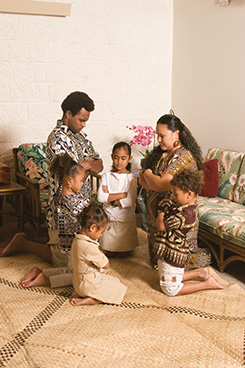
The Lord indicates that it is the responsibility of parents to teach their children to pray [see D&C 68:28]. This does not mean secret prayers only. I am sure it means to teach by example through family prayers. We need the sanctifying influence which comes from devotion in the home—prayer as a family. 
We need as families to kneel in family prayer, night and morning. Just a few words added to the blessing on the food, which is becoming the custom in some parts, is not enough. We need to get onto our knees in prayer and gratitude.
Did you catch that?  Prayers at meal time are not enough.  But, then he goes on to list some of the incredible blessings that will come to us through family prayer. (The blessing I found in the above and below quotes are in green, do you see others?)
Prayer has been and is the ever-present anchor for strength and a source of direction in our family activities. I remember kneeling at the bedside of our young children, helping them with prayers in their younger years, and later seeing the older brothers and sisters helping the younger ones. We had family prayer night and morning, with children given the opportunity to lead, and had special prayers to meet particular problems. Mention was made in family prayer, for instance, of children with [Church] assignments. … We asked for help when one of the children faced a difficult examination in high school. Special mention was made of members of the family [who were] away. … This special mention of particular concerns in our family prayers gave confidence, assurance, and strength to members of the family facing difficult problems and assignments. 
The differences and irritations of the day melt away as families approach the throne of heaven together. Unity increases. The ties of love and affection are re-enforced and the peace of heaven enters. 
In such homes secret prayers are said night and morning by members of the household. Individual and family problems are approached with confidence after invoking the favor of heaven. Young people participating in such a family devotional have hearts freed from evil intent as they leave for an evening of entertainment. These [young people] will be the restraining influence in the group when gilded temptations arise. Parents who surround their children with the refining influence of daily devotion are making their contribution to the safeguarding of the … home.
Those are some pretty great promises.  I especially appreciate that family prayer will increase our unity and re-enforce "the ties of love and affection".  And, who couldn't stand a little more of the peace of heaven in their home,  I know I could.  :)

Also, as my children are getting older and are starting to spend more time with friends, I was hopeful when I read that family and individual prayer will free our hearts of evil intent and will guide them to be the "restraining influence" in their group of friends when temptations do arise, because I know they will.

Section 3: We can improve our communication with our Heavenly Father. 

President Benson suggests five ways we can improve our communication with out Father in Heaven.
  1. Pray frequently.  He suggests at least two or three times a day.  In addition, we are told to pray always. (See 2 Ne. 32:9D&C 88:126.) This means that our hearts should be full, drawn out in prayer unto our Heavenly Father continually. 
  2. Find a place where you can pray and meditate that is free from distractions.
  3. Prepare yourself for prayer.  If we do not feel like praying, then we should pray until we do feel like praying.  President Benson also suggests that we should pray in humility and seek forgiveness and mercy.  We should also forgive others and care for the people around us.
  4. Our prayers should be meaningful and pertinent. We should avoid using the same phrases in each prayer. For what should we pray? We should pray about our work, against the power of our enemies and the devil, for our welfare and the welfare of those around us. We should counsel with the Lord regarding all our decisions and activities. (See Alma 37:36–37.) We should be grateful enough to give thanks for all we have. (See D&C 59:21.) We should confess His hand in all things. Ingratitude is one of our great sins.We should ask for what we need, taking care that we not ask for things that would be to our detriment. (See James 4:3.) We should ask for strength to overcome our problems. (See Alma 31:31–33.) We should pray for the inspiration and well-being of the President of the Church, the General Authorities, our stake president, our bishop, our quorum president, our home teachers, family members, and our civic leaders. Other suggestions could be made, but with the help of the Holy Ghost we will know about what we should pray. (See Rom. 8:26–27.)
  5. After making a request through prayer, we have a responsibility to assist in its being granted.  This reminds me of a saying I've often heard that goes: "Work like it all depends on you, pray like it all depends on the Lord."
Section 4: God is mindful of us and ready to respond to our prayers when we place our trust in Him and do that which is right.
There is power in prayer. All things are possible through prayer. It was through prayer that the heavens were opened in this dispensation... 
It is my testimony ...that God does hear and answer prayers. I have never doubted that fact. From childhood, at my mother’s knee where I first learned to pray; as a young man in my teens; as a missionary in foreign lands; as a father; as a Church leader; as a government official, I know without any question that it is possible for men and women to reach out in humility and prayer and tap that Unseen Power; to have prayers answered. Man does not stand alone, or at least, he need not stand alone. Prayer will open doors; prayer will remove barriers; prayer will ease pressures; prayer will give inner peace and comfort during times of strain and stress and difficulty. Thank God for prayer.
Even during hours of trial and anxiety, it is possible to draw close to the Lord, to feel of his influence and of his sustaining power—that one is never alone, if he will only humble himself before the Almighty. I am grateful for that testimony, for that assurance. 
It is soul-satisfying to know that God is mindful of us and ready to respond when we place our trust in Him and do that which is right. There is no place for fear among men and women who place their trust in the Almighty, who do not hesitate to humble themselves in seeking divine guidance through prayer. Though persecutions arise, though reverses come, in prayer we can find reassurance, for God will speak peace to the soul. That peace, that spirit of serenity, is life’s greatest blessing.

Discussion Questions:

  • Has there been a time when you received strength, inspiration and enlightenment through prayer?
  • How will you make family prayer a priority in your home?
  • Using President Benson's suggestions for improving communication with our Heavenly Father through prayer, in what areas can you improve?
  • What do you take from President Benson's testimony on prayer?